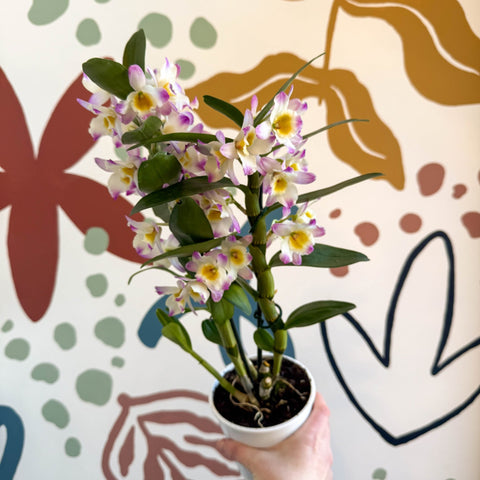
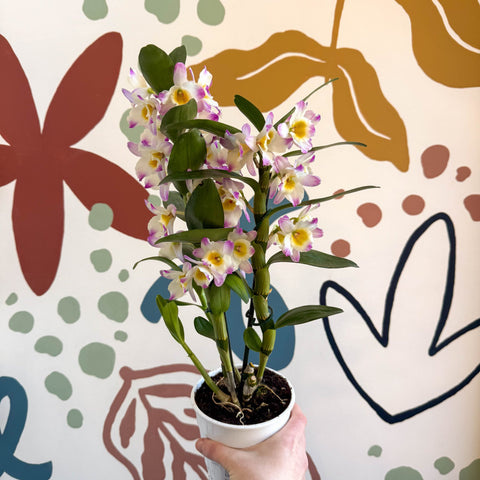
Flower spikes sprout from leaf stems, giving the Noble Orchid a lush appearance. This Cultivar's fragrant blooms are a creamy white tipped with bold, bright pink at the edges and with a golden yellow centre. Against the backdrop of the mid-green leaves which alternate sprouting on these segmented stems, the flowers and indeed the whole view of the plant are a feast for the eyes. In its natural habitat, the Dendrobium is epiphytic, growing on trees in subtropical parts of southern and eastern Asia; make sure its roots have room to breathe and you can't go far wrong.
Scientific Name
Dendrobium nobile 'Bright Eyes' (renowned tree-life plant, cultivar: bright eyes)
Synonyms: Callista nobilis, Dendrobium chlorostylum, Dendrobium coerulescens, Dendrobium formosanum, Dendrobium lindleyanum, Dendrobium wallichianum
First classified in 1830, D. nobile has retained the same scientific name ever since, though there have been other suggested names in the intervening centuries.
Common Name
Noble Orchid, Noble Rock Orchid, Bamboo Orchid, Noble Dendrobium, Nobile Orchid, Bright Eyes Noble Orchid
Origin
Native to subtropical areas in south and southeastern Asia, found in: Bangladesh, Southern China, India, Laos, Myanmar, Nepal, Thailand, Tibet and Vietnam.
Light
Avoid direct sun in spring and summer; used to shade from the forest canopy, the Noble Orchid can burn in harsh direct sun. It will benefit from a splash of morning sun in autumn and winter when there is generally less light to go around and its growth slows.
Water
Water when the top third of the soil has dried; it's especially important to keep the soil moist when your Orchid is blooming or you'll risk losing the flowers. Water with room temperature water as cold water can shock the plant, and make sure to reduce watering in winter when it'll be using less water.
Humidity
Your Noble Orchid will appreciate a spot with above-average humidity; a kitchen or bathroom can be a good idea, or using a pebble tray to increase local humidity around the plant. Signs of too-low humidity include brown, crispy leaf tips.
Soil
Use a soil designed for epiphytes like Orchids or Anthuriums here. The mix should have plenty of components like bark to promote air circulation to the roots. Repot every 2-3 years in spring while the plant is not in bloom; being slightly pot-bound can encourage your Orchid to bloom so don't repot too soon if you want to see those lovely flowers.
Food
Use a foliar Orchid feed for best results as your Noble Orchid can absorb nutrients through its leaves. Feed every couple of weeks in the growing season, reduce over winter when growth slows.
Temperature
Daytime temperatures between 18-27°C will be ideal, especially in summer, to remind this subtropical plant of home. It will need a dip in temperature of about 5°C overnight, but make sure it doesn't ever get below 10°C overnight or in winter as long periods at this lower temperature will cause damage.
Pet-safe
Yes, this Orchid is non-toxic so is safe for homes with pets and small children. Too much nobbling won't be great, so do still keep an eye on your plant and any curious hands or paws.
Sprouts Top Tips
The Noble Orchid does need some seasonal and daily changes to grow best. Once it's slowed down growth in autumn and winter, it will need slightly lower temperatures, a dash of weak morning sunlight, less water and less food to promote a proper dormancy period. Throughout the year, an overnight dip in temperatures of 5°C is perfect for encouraging blooms and healthy growth, too. If it's too consistent, your Orchid won't feel completely at home.



![The 'Hot Toddy' Fresh Foliage Christmas Wreath [Made to Order]](https://cdn.shopify.com/s/files/1/0490/2774/3905/products/the-hot-toddy-fresh-foliage-christmas-wreath-240111_500x500.jpg?v=1637626402)