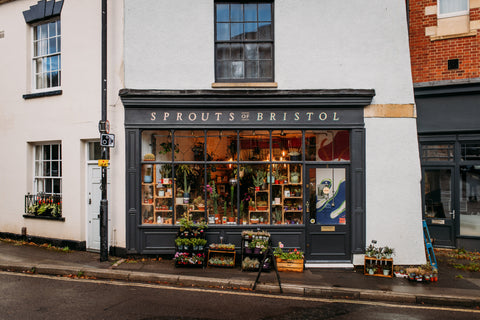
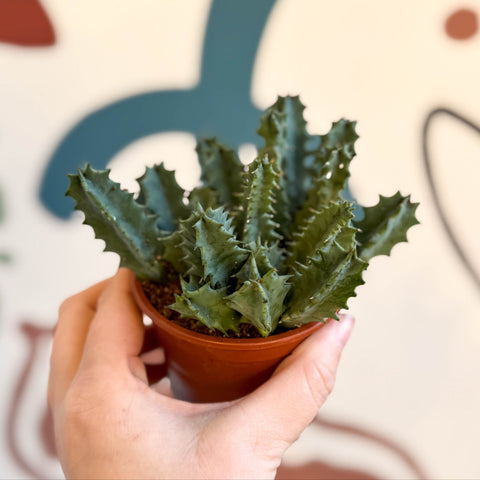
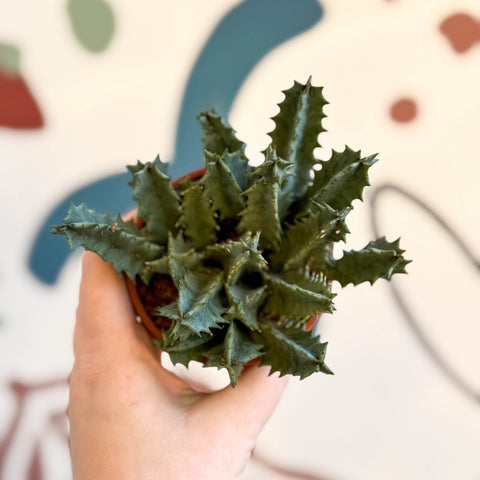
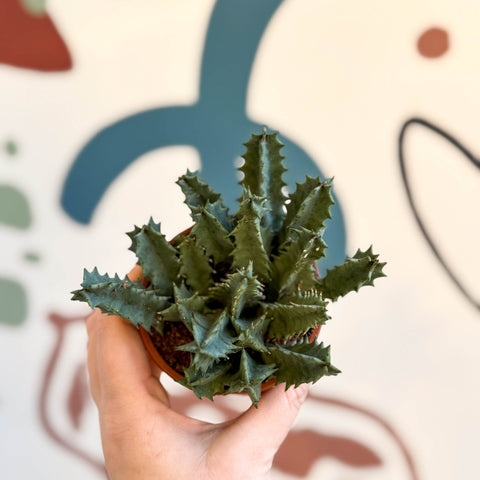
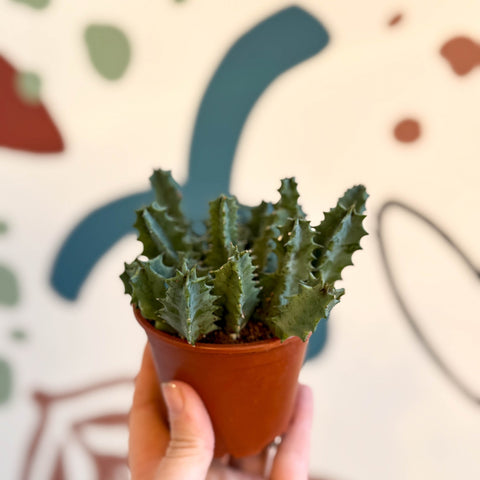
This funky succulent stands out from the crowd with its multiple short stems of spiny foliage. As your plant grows, it will spread outwards and start to trail, so don't panic if it's growing sideways rather than upwards - this is normal! It will be best displayed somewhere you can admire this foliage growth. In summer, if your plant is happy, it may give you a display of its stunning flowers. The flowers are the most remarkable feature of this plant when in bloom, with a maroon or burgundy circle like a life ring (or polo mint) in the centre surrounded by star-like petals decorated with maroon and yellow stripes. Give this plant plenty of light and not too much water and it will be at its best in your home.
Scientific Name
Huernia zebrina (Heurnius' plant with zebra stripes)
Synonyms: Ceropegia zebrina
This plant was first identified in a 1909 paper under this name and has kept it ever since. Although it was referred to as Ceropegia zebrina in a paper in 2017, Huernia zebrina is still the accepted scientific name.
Common Name(s)
Lifesaver Cactus, Little Owl Cactus, Lifebuoy Huernia, Zebra-Striped Huernia, Zebra Cactus, Carrion Flower
Origin
Native to Africa - rocky, arid areas in South Africa's KwaZulu-Natal and Northern Provinces as well as Botswana, Eswatini, Zimbabwe, Namibia and Mozambique
Light
Give your Huernia somewhere bright with a little bit of direct sun. Too much direct sunlight can scorch its stems, while insufficient light may reduce flowering. An east- or west-facing window is ideal.
Water
Allow the soil to dry out completely between waterings. Water sparingly, especially during winter when the plant won't be growing. Soggy soil can lead to root rot, so ensure the pot has proper drainage.
Humidity
Thrives in low humidity. Make sure you're keeping it somewhere with decent airflow that's not excessively damp.
Soil
Use a well-draining cactus or succulent soil; a mix with added sand or grit will work well. Make sure your pot has drainage holes. Repot every few years as the plant grows; you'll know it's ready to repot when the roots are crowding the pot.
Food
Feed once every two months during the growing season (spring and summer) with a diluted cactus or succulent fertiliser. Feeding is unnecessary in autumn and winter.
Temperature
Ideal temperatures are between 18-26°C. Protect from frost and avoid exposure to temperatures below 10°C.
Pet-safe
Yes, this plant is non-toxic to pets, making it a safe choice for households with animals.
Sprouts Top Tips
A big risk for this plant is giving it too much water; make sure the soil has totally dried out before you water again and this will help keep it happy!
The stems should droop a little, so don't worry if they are not upright. They will look best on a shelf or in a hanging pot where their dangly stems can be shown off.
Extras
The flowers of Huernia zebrina emit a faint scent similar to carrion, which helps attract pollinating flies. The scent is mild indoors, though, so don't be put off! The flowers are more than interesting enough to offset their odd smell.
Did You Know?
The genus Huernia was named by Robert Brown in honour of Dutch missionary Justin Heurnius, the first known collector of Cape of Good Hope plants. It was Brown who originated the misspelling of his name, and it stuck.

![The 'Hot Toddy' Fresh Foliage Christmas Wreath [Made to Order]](https://cdn.shopify.com/s/files/1/0490/2774/3905/products/the-hot-toddy-fresh-foliage-christmas-wreath-240111_500x500.jpg?v=1637626402)