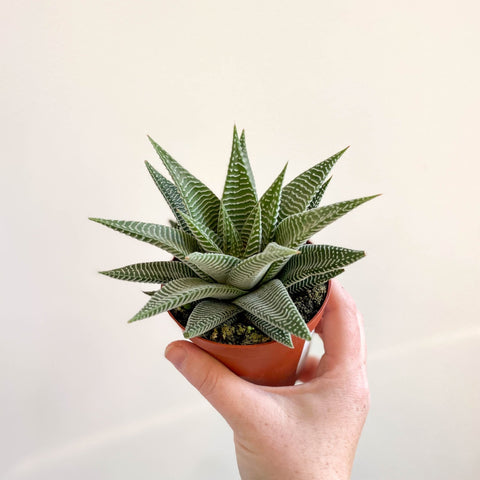
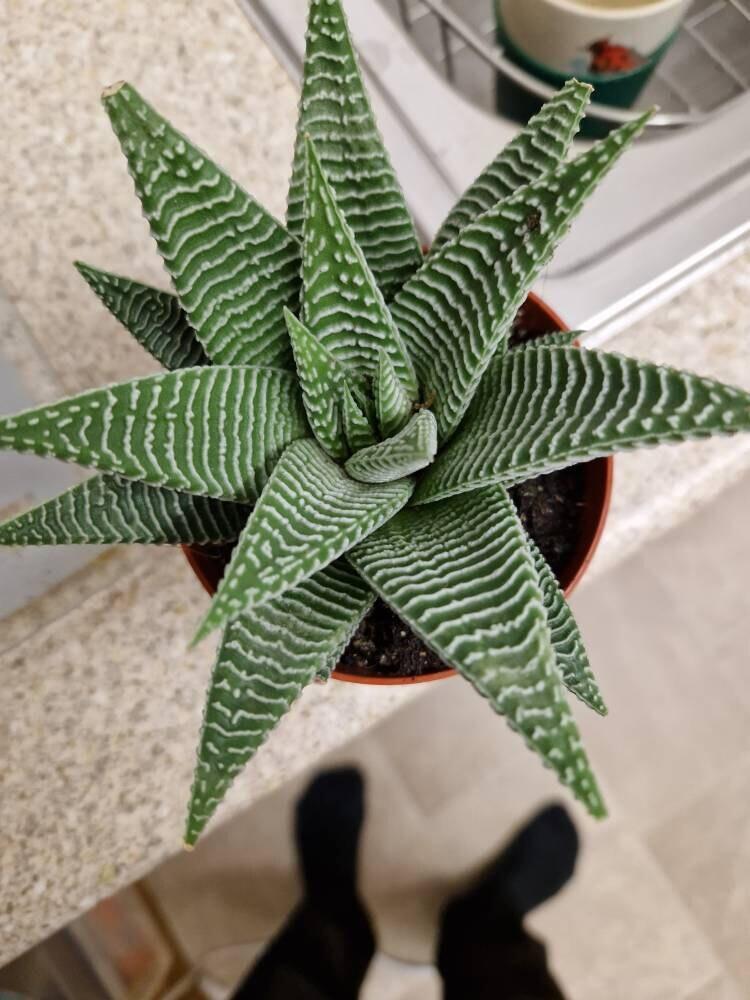
This succulent's spiky crown is striped with white ridges, which give it both is variety name 'Spider White', hinting a comparison with cobwebs, and the common name 'Fairy Washboard'; you can imagine tiny creatures washing their clothes on the tiny ridges of these leaves! It may put up a tall flower spike in summer, and may clone itself by putting out tiny pups from its root system, which you can then use to propagate. In terms of care, this succulent is easygoing as long as it gets a lot of light and infrequent waters. Treat this plant well and you'll benefit from its standout foliage, both tactile and beautiful, as it grows.
Scientific Name
Haworthia limifolia 'Spider White' (Haworth's plant with file-like leaves, cultivar: spider white)
This plant is now reclassified into the Haworthiopsis genus as Haworthiopsis limifolia.
Common Name
Fairy Washboard Plant, White Fairy Washboard, Fairy's Washboard
Origin
This plant grows wild in southern Africa
Light
Haworthias are happy in the brightest light you can offer indoors; a south- or west-facing window should give it enough direct sun.
Water
Let all of the soil dry out between waters; this plant is used to arid areas and will rot with too much water.
Humidity
Your Haworthia is used to arid air so don't keep it anywhere damp or humid.
Soil
A soil mix which drains really well will be your succulent's best friend; mix in sand and grit or look out for a soil mix designed for cacti and succulents. Repot only when its roots have totally filled the pot; succulents do well when rootbound.
Food
Feed every couple of months in summer, and every three months in winter. A feed designed for cacti/succulents will work best, or a diluted general houseplant feed.
Temperature
Your Haworthia likes summer temperatures of 18-25°C, but will prefer to be slightly cooler in winter. Make sure it does not get colder than 10°C.
Pet-safe
Yes, but too much nibbling won't be good for pets, small humans or the plant!
Sprouts Top Tips
Haworthias propagate by putting out tiny pups from their roots to the side of the main plant. You can propagate by carefully separating these, once they have at least four leaves and some roots of their own, and placing them in their own little pot.