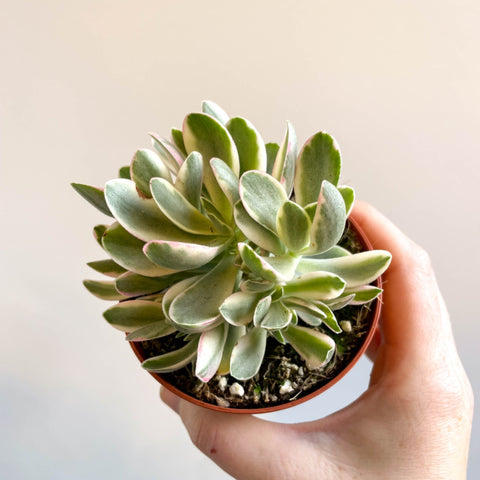
This succulent's fleshy leaves are stunning in colour with their pale green centres and white variegated edges. They are also gorgeously velvety to the touch, adding an amazing type of texture to your succulent collection! Easygoing in the right spot, this plant likes bright light and plenty of time for its soil to dry out between watering. Add this gorgeous foliage to your collection and watch it grow more pretty, pretty leaves.
Scientific Name
Crassula swaziensis variegata 'Money Maker' (thick-leaved plant from Swaziland, variegated variety, cultivar: money maker)
This species has been reclassified; it is now properly known as Crassula globularioides subsp. argyrophylla, a subspecies within the species C. globularioides. (meaning: globular-like thick-leaved plant with silver leaves)
Common Name
Money Maker Plant, Moneymaker, Variegated Crassula
Origin
This plant is originally from South Africa
Light
Bright light is important for Crassula, so pick a spot where it can get a few hours of morning or evening sun. Its variegation will start to vanish if there is not enough light, so keep an eye on its stripes!
Water
Let all of the soil dry out between waters; remember, in its natural habitat this plant is used to droughts between infrequent downpours. Cold water can shock the plant, so make sure your water is room-temperature at least before watering.
Humidity
Crassulas are used to low humidity, so don't keep it anywhere damp. An occasional hose down will keep the leaves free of dust, but make sure it dries out completely afterwards.
Soil
Use a well-draining soil mix with components such as sand and grit; a mix designed for cacti and succulents will work well here. Repot every 2-3 years in the spring.
Food
Feed every two months in the growing season, reduce to every three in autumn and winter.
Temperature
Ideal temperature is 15-26°C; make sure it does not get colder than 12°C in winter.
Pet-safe
No, this plant is toxic to pets and small humans.
Sprouts Top Tips
Keep an eye on the colour of the leaves to check on some of the most common issues with Crassula. If the leaves start to go red (aside from their natural variegation), this is a sign of sunburn and they should be gradually moved to a location with less direct sun. If the leaves are going yellow, however, the plant is probably too damp, and will benefit from brighter light and less frequent watering.