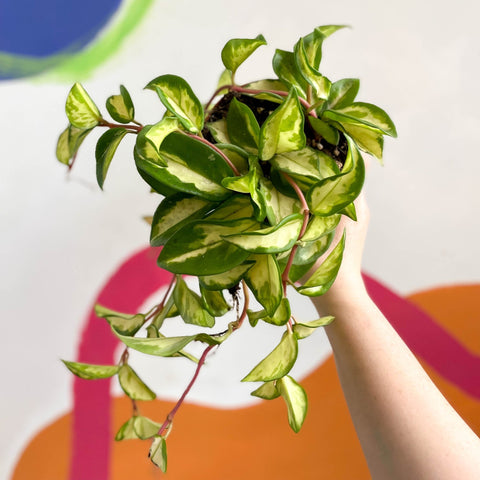
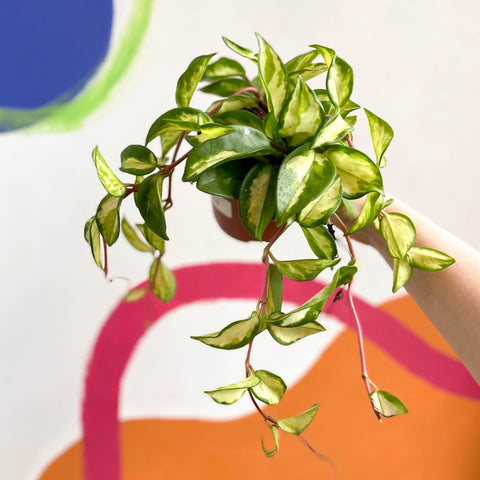
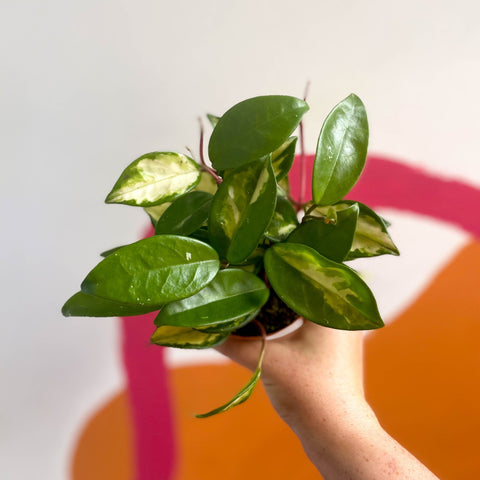
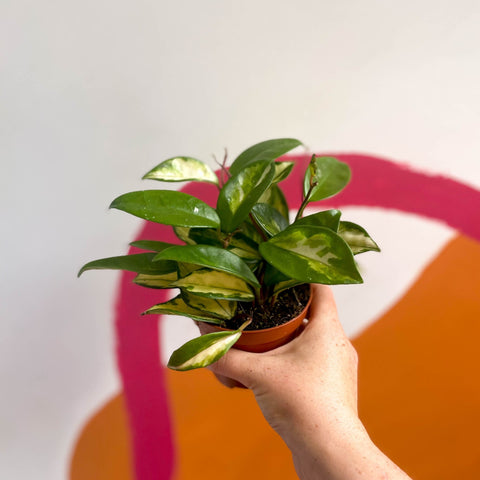
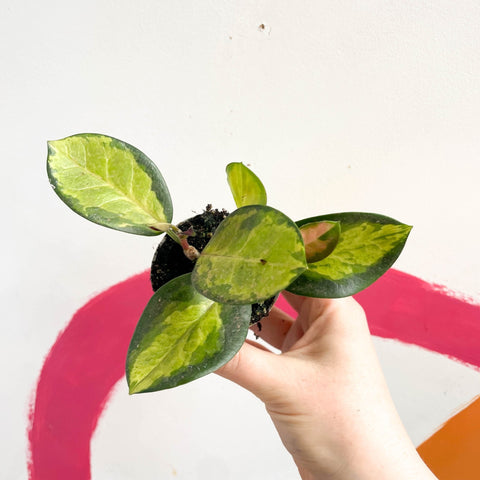
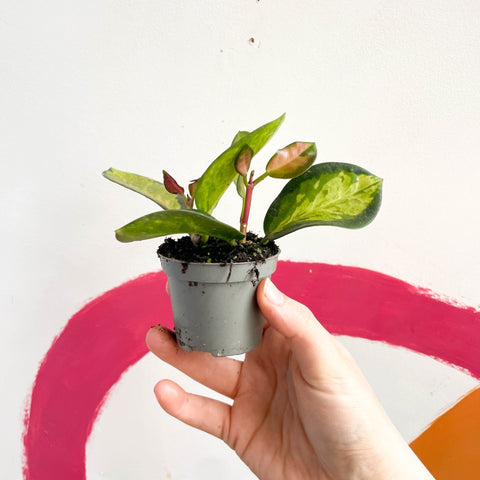
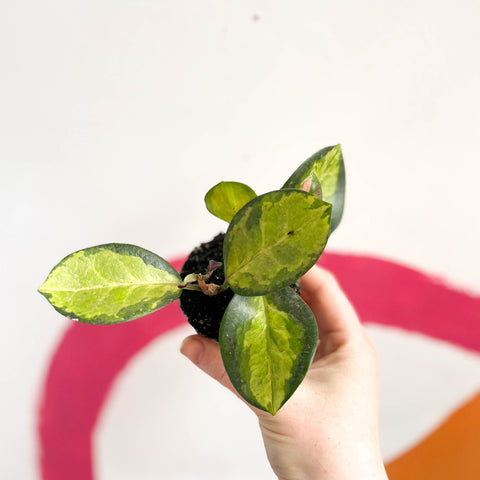
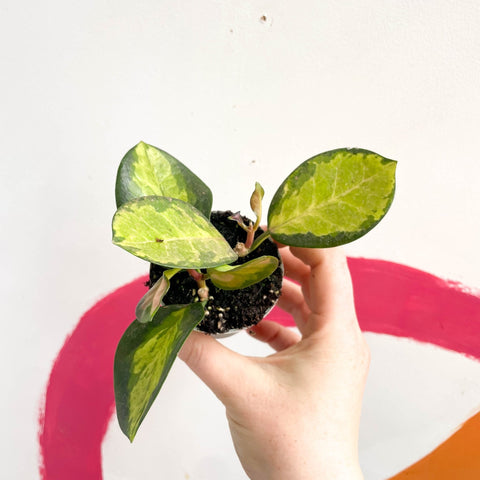
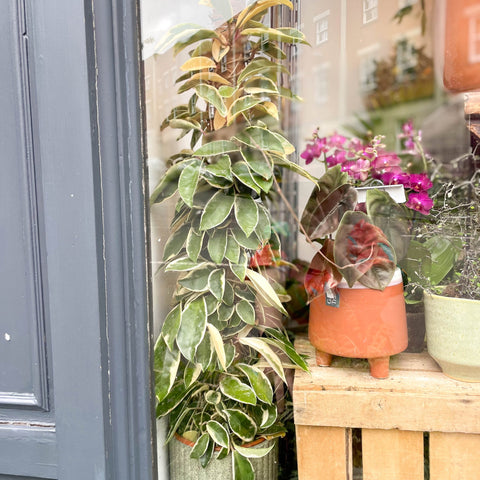
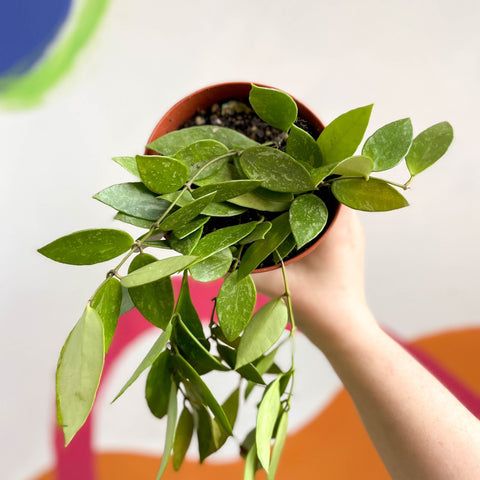
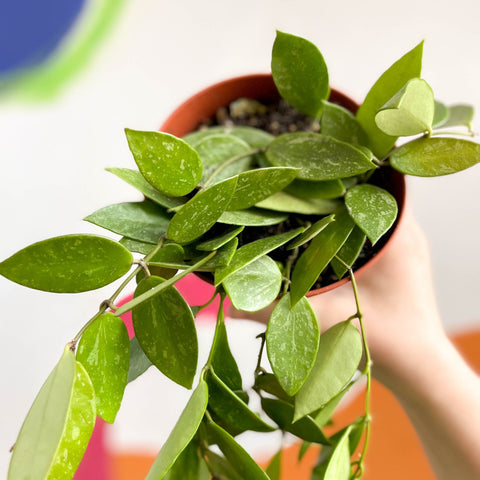
Admire all three shades of foliage colour by taking this plant home to grow and gaze at. Bright crimson stems and green foliage with cream centres gives this triple threat variegation plenty to admire. New growth sprouts with a tint of pink, and each new pair of leaves starts tiny at the end of a stem and grows to fit. As the plant matures, you'll also see the leaves tilting inwards to give them a slim, textured appearance. A vining plant like amny of its Hoya relatives, you can train this plant up a lattice or other structure, or let it all hang loose from a hanging pot or trailing on a high shelf. In a bright spot, and with care taken not to overwater, this Hoya will reward you with stunning, three-coloured foliage and maybe even sweetly-scented pink blooms if it's really happy.
Scientific Name
Hoya carnosa var. variegata 'Tricolor' / 'Krimson Queen' (Hoy's meaty plant, variegated variety. Cultivar: three-colour / crimson queen)
Synonyms: Asclepias carnosa, Cynanchum carnosum, Hoya carnosa f. variegata, Hoya chinensis, Hoya compacta, Hoya crassifolia, Hoya intermedia, Hoya laurifolia, Hoya variegata, Hoya skinneriana, Stapelia chinensis, Schollia chinensis
Reclassified in 1810 from Asclepias carnosa to Hoya Carnosa, specimens of this plant have been identified under quite a few other names only to be later identified as H. carnosa. The variety variegata is as yet unplaced in the WFO taxonomic database.
Common Name
Crimson Queen Hoya, Tricolour Hoya, Wax Plant, Porcelain Flower, Wax Flower, Honey Plant
Origin
This Hoya is native to Southeastern China, Japan, Laos and Taiwan
Light
Thrives in bright, indirect light, and will benefit from a splash of morning or evening sun. Make sure it gets 1-2 hours of direct sunlight in autumn and winter, throughout its dormant period.
Water
Allow the top third of the soil to dry out between waters, and reduce watering in winter and in dimmer spots. Make sure you don't leave any water sitting in the foliage (or flowers) as this can cause damage.
Humidity
Used to a rainforest environment, this plant likes air with above-average humidity; introduce a pebble tray if possible, and hose down the leaves regularly to keep them free of dust. If the leaves start to brown and curl, this is a sign that the air is too dry.
Soil
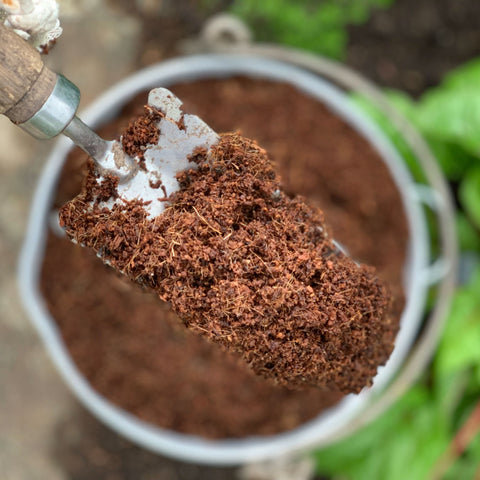
Use an anthurium mix, or one with plenty of airflow introduced by elements like bark. Repot every three years in spring as the plant grows. Don't repot whiule it's flowering; wait until wfterwards, so it doesn't lose its blooms from transplant shock.
Food
Feed every four waters throughout the year. To tailor your feeding even more, look for a Nitrogen-heavy fertiliser when the foliage needs to develop more, and to encourage flowers once it's mature look for one with higher Potassium (K) content, like tomato feed.
Temperature
Ideal temperature is between 15-27°C; make sure it does not get colder than 15°C in winter or for longer periods.
Pet-safe
Hoya are not toxic but can have bad reactions for your pets, including vomiting/ diarrhoea
Sprouts Top Tips
While this plant likes it humid, it does not like soggy soil - make sure not to over-water it. Keep an eye out for yellowing leaves, especially those closer to the soil, to spot this early and reduce the frequency of your waters before the roots are damaged.
Did You Know?
This plant has been cultivated for a long time so has adapted to be more comfortable in our homes and more tolerant to cooler temperatures!