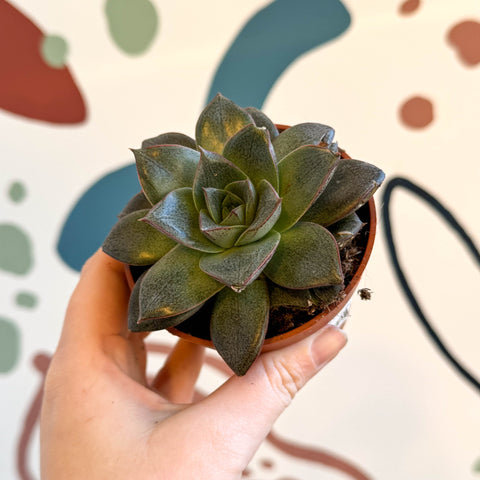
This striking succulent grows rosettes of fleshy, deep green leaves with hints of red and purple colour. This colour gets more vibrant in brighter light, so keep an eye on the colour to track its light needs - and don't be surprised if the colour changes a little over winter! These deep shades stand out in any succulent collection, so don't hesitate to add it to yours. Keep it happy with plenty of light - it can stand some direct sun - and by letting its soil fully dry between waters.
Scientific Name
Echeveria x purpusorum (Echeverría's plant, hybrid with Purpus' species)
Synonyms: Echeveria purpurea, Urbinia purpusii, Echeveria purpusorum, Echeveria dionysos, Echeveria chinensis, Echeveria
This cultivar is a hybrid between two species of Echeveria; one is E. purpusorum, the other is unknown.
Common Name(s)
Purple Echeveria, Echeveria 'Dionysos', Echeveria 'Bacchus', Mexican Hens & Chicks
Origin
This cultivar's parent plant is native to Central and Southwestern Mexico.
Light
Your Echeveria needs bright light to keep it vibrant, healthy and growing. A couple of hours of direct sun in the morning or evening will help it keep that lovely vibrant colouring.
Water
Make sure the soil totally dries out between waters; remember this will take longer in winter, or any time there is less sun and heat.
Humidity
Accustomed to arid environments, your Echeveria will thrive best in low humidity. Just make sure it's not anywhere excessively damp.
Soil
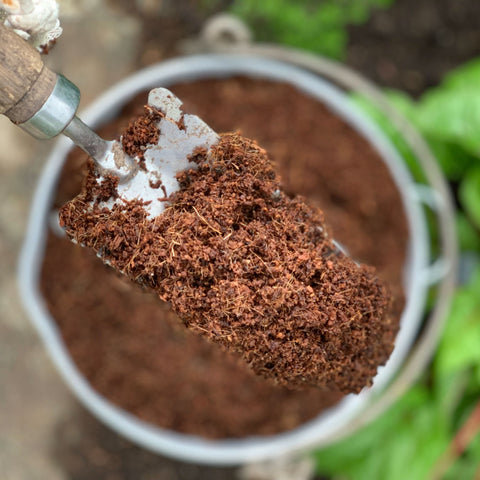
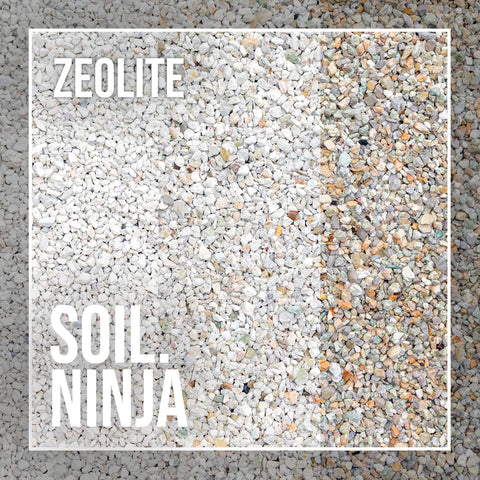
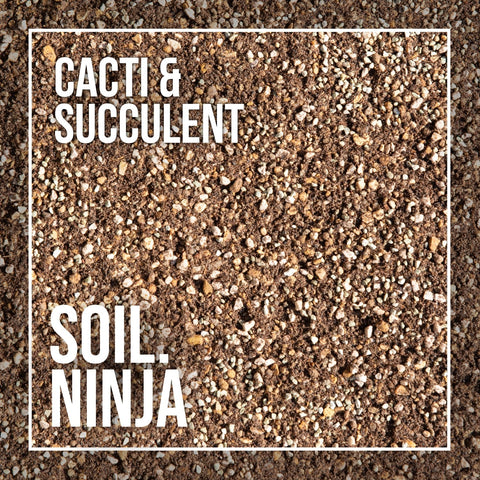
Your Echeveria needs a well-draining soil. One with added sand and grit, or a mix designed for cacti and succulents, will help it thrive. Repot every few years in spring as the plant grows.
Food
Feed with a diluted cactus or houseplant feed every couple of months in the growing season; feeding is not necessary in autumn and winter.
Temperature
Your Echeveria will like temperatures between 15-26°C. Make sure it doesn't get colder than 5°C in winter; this succulent is not tolerant to frost.
Pet-safe
Yes, this plant is non-toxic so is a safe choice for furry friends.
Sprouts Top Tips
Rotate gradualluy to keep growth even.
If you're moving it to a brighter location, let it acclimatise gradually.
Extras
You may get tall flower stalks on your Echeveria in summer.