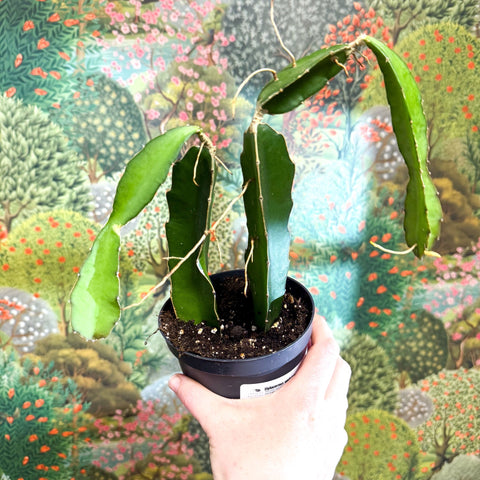
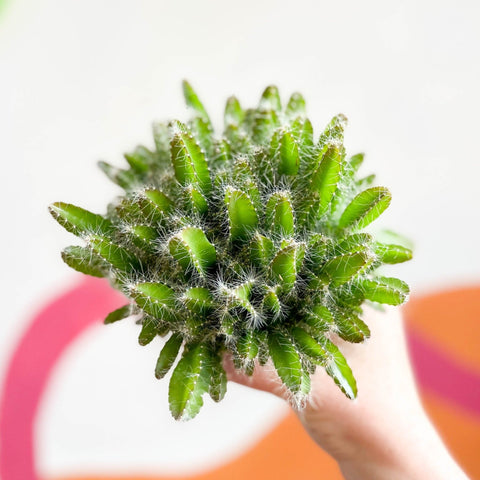
The Dragon Fruit plant has a fountain of spiky green stems which are beautiful and vibrant even before blooming or fruiting. Whilst they are quite happy as houseplants, you may not get them fruiting indoors - but that doesn't mean you can't still enjoy the foliage and possibly flowers! In its native South America, it is fast-growing, scaling trees and houses alike to display its cream-coloured blooms and distinctive bright pink fruits. In your home, you can enjoy the foliage and either train it on a trellis or other support, or let it hang or trail. Keep it in a bright spot, let the soil dry between waters, and watch this plant thrive
Scientific Name
Selenicereus undatus (wavy moon-wax plant)
Synonyms: Hylocereus undatus, Cereus tricostatus, Cereus undatus, Hylocereus tricostatus, Selenicereus undatus subsp. luteocarpus, Hylocereus undatus subsp. luteocarpus
Reclassified from Hylocereus undatus to Selenicereus undatus in 2017
Common Name(s)
Dragon Fruit, Red Pitaya, Pitahaya, Night-Blooming Cereus, Celle of the Night, Queen of the Night, Strawberry Pear, Moonlight Cactus
Origin
Native to Central and South America, from Mexico to Honduras
Light
This plant will love a bright spot where it gets a couple of hours of morning or evening sun and bright, indirect light the rest of the day. Near an east- or west-facing window would be ideal for this plant. Too much sun in summer can scorch this plant, while too little leaves it vulnerable to rot.
Water
Let this plant dry out almost entirely between waters. It can be very drought tolerant if needed, but it's best not to test this out too regularly. Reduce watering in autumn and winter when the plant will be dormant and not growing.
Humidity
Average humidity is fine for the Dragon Fruit plant; make sure it is not too close to operating radiators which will dry it out too much, or in a really damp environment that puts it at risk of rotting.
Soil
Use a well-draining cactus or succulent mix. These mixes should contain sand or grit to help improve aeration. Ensure the pot has drainage holes to prevent waterlogging. Repot every 2-3 years to refresh the soil and accommodate growth.
Food
Feed monthly during the growing season (spring to summer) with a balanced, water-soluble fertiliser. In autumn and winter, reduce feeding to once every 6-8 weeks or stop entirely when the plant is dormant.
When the plant is budding or in bloom, use a feed high in potassium, such as a tomato feed, to keep it flowering longer.
Temperature
Ideal temperatures range from 15-26°C. Protect the plant from frost and avoid exposure to temperatures below 10°C.
Pet-safe
Yes, they are non-toxic, but too much nibbling won't be good for pets, small humans or the plant! Just watch out for their spiky stems.
Sprouts Top Tips
You can use a sturdy trellis or pole to train the plant upward as it grows. Prune the plant in spring if necessary to manage its size and encourage healthy growth.
Did You Know?
Hylocereus undatus is a night-blooming plant with large, fragrant flowers that open for a single night. Pollination by bats, moths, or by hand is required for fruit production.