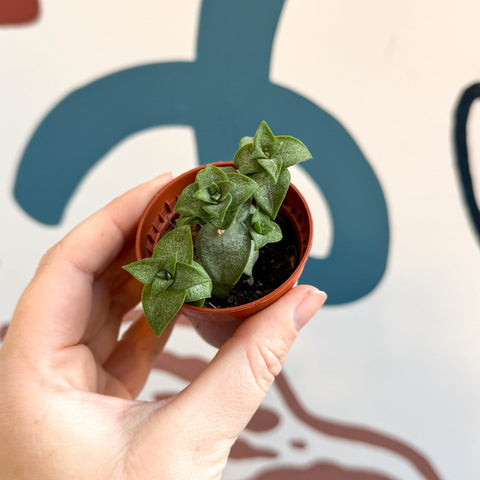
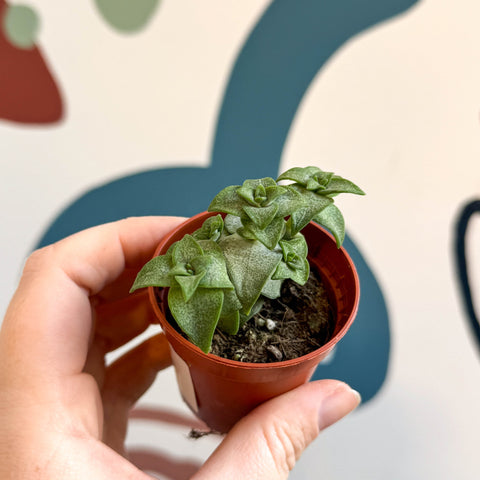
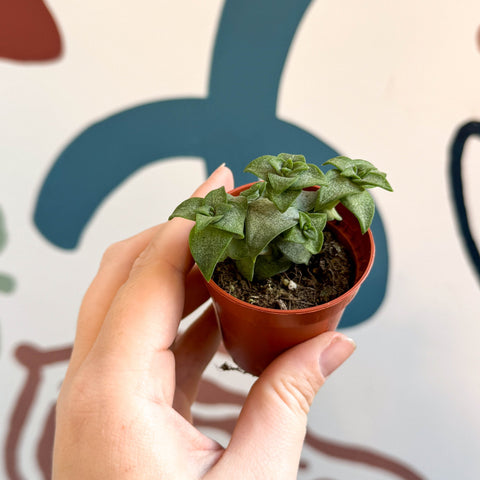
Add this distinctive Crassula to your succulent collection and your eyes will keep being drawn back to its silver-speckled triangular leaves. These leaves grow in pairs, stacking one on top of the other in branching stems which sprout gorgeous leaves combining sturdy succulent characteristics with apparent delicacy as they taper to elegant points at each leaf tip. Keep this plant happy with a splash of direct sun and not too much water and it will give you plenty of elegant foliage to admire.
Scientific Name
Crassula perforata (thick-leaved plant which appears to have small holes)
Synonyms: Sedum perfossum, Crassula anthurus, Crassula conjuncta, Crassula connata, Crassula coronata, Crassula nealeana, Crassula patersoniae, Crassula perfossa, Crassula punctata, Crassula perfilata
This plant has been described under several different names in various scientific publications over the last few centuries, however the accepted name is Crassula perforata, first attested in a 1778 paper, and accepted on the authority of the 1999 World Checklist of Seed Plants
Common Name(s)
String of Buttons, Necklace Vine, Pagoda Plant, Stacked Crassula, Khaki Button
Origin
Native to Southern Africa (arid areas in the Cape Provinces of South Africa and KwaZulu-Natal)
Light
Crassula love a bit of sun; to get the best growth, a south- or west-facing window will suit. Watch out for harsh midday sun in summer, as on the hottest days this can start to scorch your Crassula.
Water
Your plant needs its roots to dry between waters, so make sure you leave plenty of time between waters. If the roots are damp all the time, you risk rotting them.
Humidity
Adapted to arid conditions, this plant is fine in low humidity; just make sure it isn't anywhere especially damp.
Soil
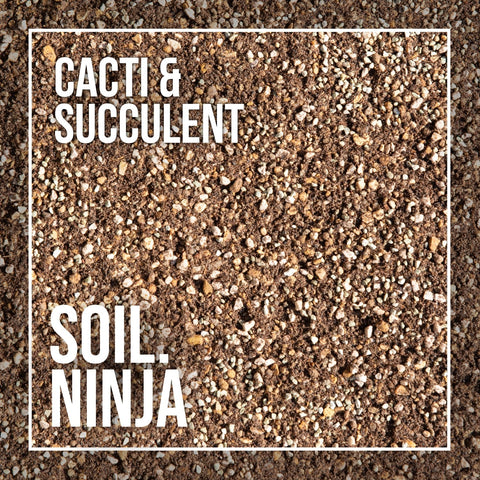
Use a well-draining cactus or succulent potting mix, or one with added grit, sand or perlite. A shallow pot with drainage holes is ideal for this plant. Repot every few years in spring as the plant grows.
Food
Feed every couple of months in the spring/summer growing season. A diluted houseplant or cactus & succulent feed will work well. Feeding over winter is not necessary as the plant will be growing much less.
Temperature
Ideal temperature is 15-26°C; make sure it does not get colder than 12°C in winter.
Pet-safe
No, this plant is toxic if ingested. Keep out of reach of pets and children.
Sprouts Top Tips
To keep the plant compact and not leggy, provide it with plenty of bright light. The most common issues come from overwatering, so make sure that the soil is totally dry before you water again and remember to leave longer between waters in winter. Rotate the pot occasionally to ensure even growth.