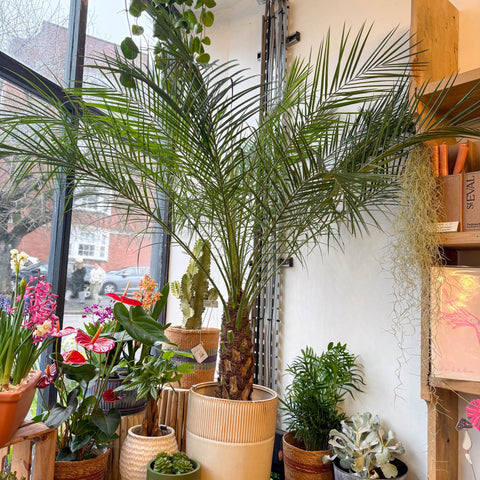
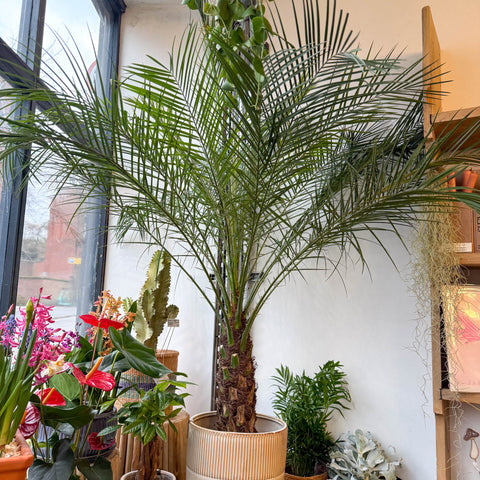
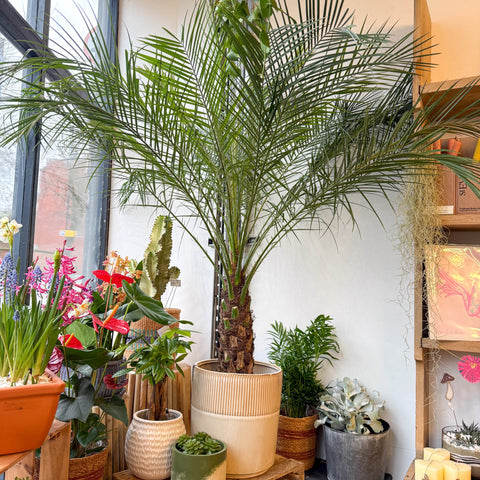
Phoenix roebelenii (Zwerg-Dattelpalme) ist eine anmutige, langsam wachsende Palme mit eleganten, gebogenen Wedeln und zarten, federartigen Blättern. Diese kompakte Palme ist eine beliebte Wahl für Liebhaber von Zimmerpflanzen, verleiht jedem Raum einen tropischen Touch und eignet sich gut für helle Räume oder Wintergärten.
Wissenschaftlicher Name
Phoenix roebelenii (Zwerg-Dattelpalme)
Gängiger Name
Zwerg-Dattelpalme, Pygmäen-Dattelpalme
Herkunft
Heimisch in Südostasien, insbesondere Laos und Vietnam, wo sie an Flussufern und in tropischen Wäldern wächst.
Licht
Gedeiht in hellem, indirektem Licht, verträgt aber auch etwas direkte Sonne. Sie kann sich an weniger Lichtbedingungen anpassen, obwohl das Wachstum dann langsamer sein und die Wedel spärlicher werden können.
Wasser
Halten Sie die Erde gleichmäßig feucht, aber nicht durchnässt. Lassen Sie die oberste Erdschicht zwischen den Wassergaben trocknen. Im Winter, wenn das Wachstum langsamer ist, weniger häufig gießen. Vermeiden Sie, dass die Wurzeln im Wasser stehen, da dies zu Wurzelfäule führen kann.
Luftfeuchtigkeit
Bevorzugt mäßige bis hohe Luftfeuchtigkeit. Wenn die Luft trocken ist, gelegentlich besprühen, ein Kieselsteintablett verwenden oder in die Nähe eines Luftbefeuchters stellen, um ein Braunwerden der Blätter zu verhindern. Ideal für Bäder oder Küchen, wo die Luftfeuchtigkeit von Natur aus höher ist.
Erde
Verwenden Sie eine gut durchlässige Blumenerde mit zugesetztem Sand oder Perlit zur Belüftung. Eine palmen- oder allgemeine Zimmerpflanzenmischung funktioniert gut. Alle 2–3 Jahre umtopfen oder wenn die Wurzeln zu dicht werden.
Düngung
Alle 4–6 Wochen im Frühjahr und Sommer mit einem ausgewogenen Flüssigdünger düngen. Im Herbst und Winter die Düngung reduzieren.
Temperatur
Bevorzugt warme Temperaturen zwischen 18–27°C. Vermeiden Sie Zugluft und Temperaturen unter 10°C.
Haustiersicher
Bei Einnahme leicht giftig; von Haustieren und Kindern fernhalten.
Sprouts Top-Tipps
Wenn die Blattspitzen braun werden, überprüfen Sie die Luftfeuchtigkeit und passen Sie die Bewässerung an – trockene Luft oder ungleichmäßige Feuchtigkeit können zu knusprigen Wedeln führen.