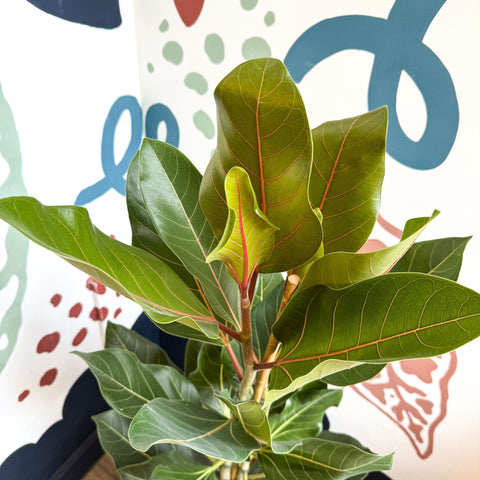
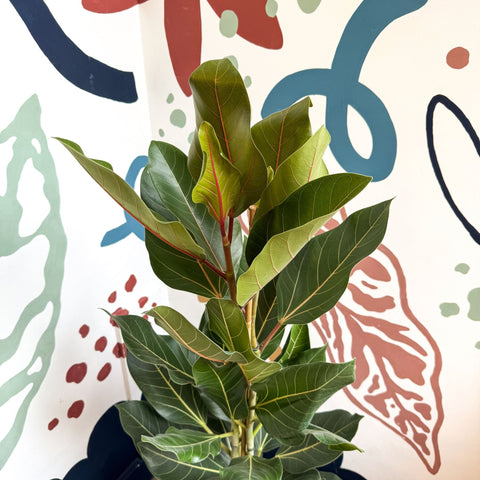
Mit seinen breiten, samtigen Blättern und der kräftigen, cremeweißen Äderung ist Ficus benghalensis ‘Joy’ eine atemberaubende Sorte des Indischen Banyanbaums. Auch bekannt als Bengalischer Feigenbaum, vereint diese Sorte die architektonische Präsenz eines Geigenfeigenbaums mit dem beeindruckenden Kontrast panaschierten Laubs. In Innenräumen wächst er zu einer hohen, aufrechten Statement-Pflanze mit skulpturaler Anmutung heran – ideal für helle Ecken und moderne Interieurs.
Wissenschaftlicher Name
Ficus benghalensis ‘Joy’
(benghalensis = „aus Bengalen“, bezieht sich auf die Herkunftsregion; ‘Joy’ = kultivierte Sorte mit kräftiger Panaschierung)
Synonyme
Banyan-Feige ‘Joy’, Bengalischer Feigenbaum, Indischer Banyan ‘Joy’
Trivialname
Bengalischer Feigenbaum, Panaschierte Banyan-Feige, Ficus ‘Joy’
Herkunft
Die Art ist in Indien, Sri Lanka und Teilen Südostasiens beheimatet, wo sie für ihr ausladendes Blätterdach und ihre Luftwurzeln bekannt ist. ‘Joy’ ist eine kultivierte Indoor-Sorte, die wegen ihres kompakten Wuchses und ihrer auffälligen Blattpanaschierung ausgewählt wurde.
Licht
Gedeiht in hellem, indirektem Licht. Ein paar Stunden sanfte direkte Sonne (morgens oder spätnachmittags) können die Panaschierung intensivieren, aber vermeiden Sie harte Mittagssonne, die die Blätter verbrennen kann.
Wasser
Gießen Sie, wenn sich die obersten 3–5 cm Erde trocken anfühlen. Bevorzugt gleichmäßige Feuchtigkeit, mag aber keine durchnässte Erde. Reduzieren Sie die Bewässerungshäufigkeit im Winter.
Luftfeuchtigkeit
Verträgt durchschnittliche Raumluftfeuchtigkeit, schätzt aber bei trockenen Bedingungen, insbesondere während der Heizperiode, gelegentliches Besprühen.
Erde
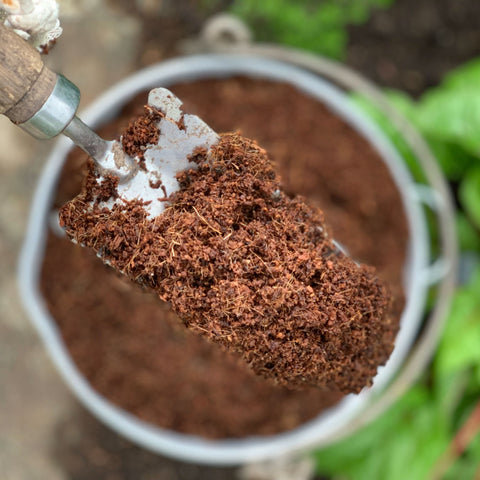
Verwenden Sie eine gut durchlässige, lehmige Blumenerde – idealerweise eine Mischung aus Kompost, Rinde und Perlit oder Sand zur Verbesserung der Drainage. Ein schwererer Topf kann dazu beitragen, die Pflanze im Alter zu stabilisieren.
Düngung
Düngen Sie alle 4–6 Wochen im Frühjahr und Sommer mit einem ausgewogenen, verdünnten Flüssigdünger. Reduzieren Sie die Düngung in den kühleren Monaten.
Temperatur
Bevorzugt Temperaturen zwischen 18–26°C. Vermeiden Sie kalte Zugluft und plötzliche Temperaturabfälle – setzen Sie die Pflanze keinen Temperaturen unter 15°C aus.
Haustiersicher
Nein – Ficus-Arten sind bei Verzehr durch Haustiere und Menschen giftig.
Sprouts Top-Tipps
Drehen Sie Ihre Pflanze alle paar Wochen, um aufrechtes Wachstum und eine ausgewogene Panaschierung zu fördern. Wischen Sie die Blätter vorsichtig mit einem feuchten Tuch ab, um sie sauber und lebendig zu halten. Im Frühjahr leicht zurückschneiden, um die Form zu erhalten und die Verzweigung anzuregen.