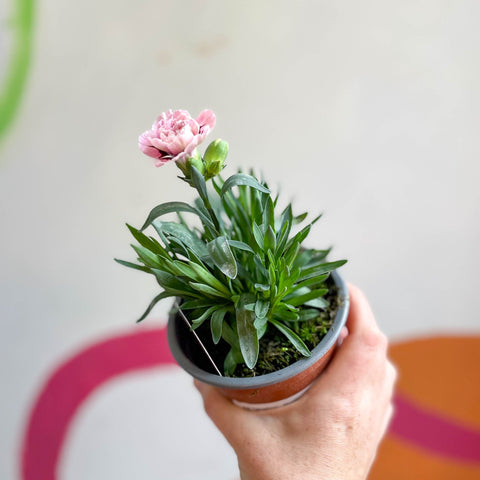
Die blassrosa Blüten dieser Staude haben tiefviolette Zentren und sprießen zwischen leuchtend immergrünem Laub hervor. Winterhart in den meisten Teilen des Vereinigten Königreichs bis -10°C.
Diese kühnen, duftenden, errötenden rosa- und pflaumenfarbenen Blüten ziehen die Blicke auf sich und fallen sowohl durch ihre Farbe als auch durch ihren Muskatnuss-Vanille-Duft auf. Der Saft der Dianthus kann reizend wirken, daher ist es ratsam, beim Umgang mit ihr Handschuhe zu tragen, aber es lohnt sich für den atemberaubenden Farbtupfer, den sie in Ihren Garten bringt! Wählen Sie einen hellen Platz mit gut durchlässigem, nicht saurem Boden und beobachten Sie, wie diese leuchtenden Blüten gedeihen.
Staude
|
Blume: buschiger Laubwuchs
|
Blüht vom Frühling bis zum Sommer, ganzjährig belaubt
|
Wissenschaftlicher Name
Dianthus caryophyllus 'Oscar Purple Star' (Zweiblumen, Nelkenblatt, Sorte: Oscar Purple Star)
Deutscher Name
Nelke, Dianthus, Feder-Nelke, Topfnelke, Carnadine
Herkunft
Heimisch im Mittelmeerraum, von Spanien bis zur Türkei.
Schnitt-Tipps
Regelmäßig Verblühtes entfernen, um eine längere Blüte zu fördern. Nach der Frühlingsblüte leicht zurückschneiden, um eine kompakte Größe zu erhalten.
Wert für die Tierwelt
Bietet Pollen für Bestäuber wie Bienen und Schmetterlinge.
Standort
Liebt volle Sonne und kann sowohl an einem exponierten als auch an einem geschützten Ort stehen.
Wasser
Diese Pflanzen mögen eher feuchten, aber nicht durchnässten Boden. Sie sollten nur bei trockenem Wetter zusätzlich bewässert werden, also behalten Sie sie bei der nächsten Hitzewelle im Auge!
Boden
Der Boden sollte gut durchlässig sein; diese Pflanze mag keinen durchnässten Boden. Verwenden Sie neutralen oder alkalischen Boden.
Nahrung
Profitiert von zusätzlichen Nährstoffen während der Blütezeit; verwenden Sie einen kaliumreichen Dünger (z.B. Tomatendünger), um schöne Blüten zu erhalten.
Haustiersicher
Nein, diese Pflanze ist giftig, wenn sie von Haustieren und Menschen gegessen wird, und reizt die Haut bei Kontakt.
Sprouts Top-Tipps
Ihre Dianthus kann nach einigen Jahren am Stängel verholzen und spärlich werden; wenn Sie sie schön kompakt halten möchten, können Sie sie vermehren, indem Sie jedes Jahr Stecklinge nehmen und neu pflanzen. Kaninchen lieben es, an Dianthus zu knabbern, daher ist dies vielleicht nichts für Ihren Garten, wenn Sie Kaninchen in der Nachbarschaft haben!