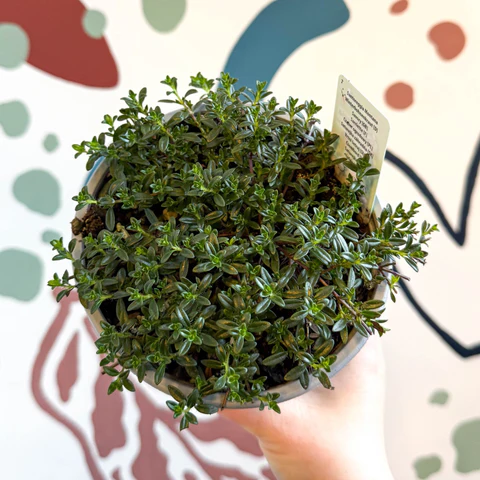
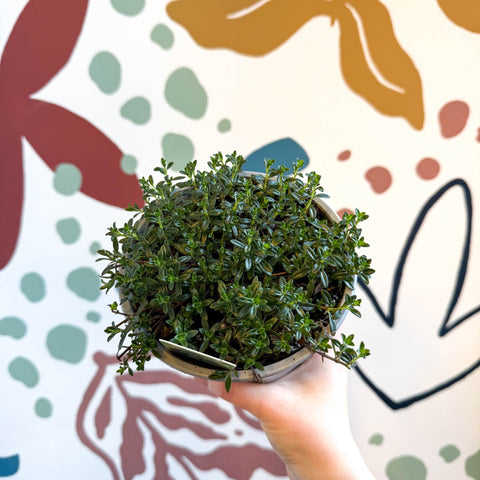
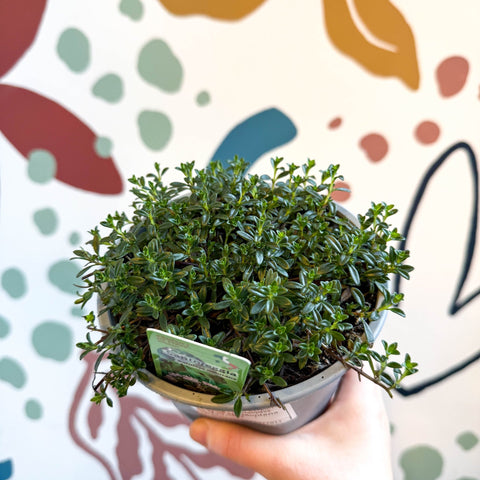
Der starke, pfeffrige Geschmack dieses Küchenkrauts verleiht Ihrem Garten und Ihrer Küche Lebendigkeit und Duft. Winterhart in den meisten Teilen Großbritanniens bis -15°C.
Das Winterbohnenkraut wurde im Laufe der Jahre sowohl in der Küche als auch in der Medizin verwendet, und sein pfeffriger Geschmack wird eine willkommene Ergänzung Ihres kulinarischen Repertoires sein. Verwenden Sie es, um Füllungen, Hülsenfrüchten und Kräutermischungen, sowohl frisch als auch getrocknet, eine würzige Note zu verleihen, und erfreuen Sie sich daran, es selbst angebaut zu haben. Als Halbstrauch kann er eine Höhe von bis zu 40 cm erreichen und im Sommer winzige rosa-violette Blüten bilden. Dieser vielseitige Strauch eignet sich sowohl für den Anbau in Töpfen als auch in Beeten in Ihrem Garten und gedeiht gut an einem sonnigen Standort mit gut durchlässigem Boden.
Halbimmergrüne Staude
|
Buschiger Halbstrauch
|
Blattwerk Frühling bis Herbst, Blüten im Sommer
|
Wissenschaftlicher Name
Satureja montana (Bergbohnenkraut)
Gebräuchlicher Name
Winterbohnenkraut, Bergbohnenkraut
Herkunft
Heimisch in Europa, zu finden in Albanien, Österreich, Frankreich, Griechenland, Italien, Libanon, Syrien, Spanien, Türkei und den nordwestlichen Balkanstaaten.
Schnitt-Tipps
Nach der Blüte zurückschneiden, um die Pflanze kompakt zu halten; alte Triebe im zeitigen Frühjahr zurückschneiden.
Wert für die Tierwelt
Bietet wertvollen Nektar und Pollen für Honigbienen und andere Bestäuber.
Standort
Volle Sonne; Winterbohnenkraut wächst sowohl an windgeschützten als auch an windexponierten Standorten.
Wasser
Trockenheitstolerant, sobald etabliert; Sie müssen diese Pflanze nur bei außergewöhnlich trockenem Wetter gießen.
Boden
Verwenden Sie gut durchlässigen Boden; wächst am besten in lehmigem Boden mit einem neutralen bis alkalischen pH-Wert.
Nahrung
Im Allgemeinen gut ohne zusätzliche Düngung, aber wenn Sie häufig ernten, ist eine gelegentliche Düngung hilfreich, besonders beim Anbau in Töpfen.
Haustiersicher
Ja, dieses Kraut ist für Haustiere, einschließlich Hunde und Katzen, ungiftig.
Sprouts Top-Tipps
Halten Sie diese Pflanze beschnitten, um frisches Wachstum zu fördern und ein Verholzen zu verhindern – perfekt für den häufigen Gebrauch in der Küche.
Das Anbringen von Mulch um die Basis Ihres Bohnenkrauts hilft, Unkraut abzuschrecken und ein völliges Austrocknen im Sommer zu verhindern.
Wussten Sie schon?
Winterbohnenkraut ist seit Jahrtausenden für seine Vorteile für Bienen bekannt – im ersten Jahrhundert v. Chr. wurde es in Virgils Georgica zum Anbau um Bienenstöcke empfohlen.